A busy restaurant cannot always wait until equipment stops working to determine which component it needs. Commercial cooking and food-service appliances contain switches, controls, heating components, sensors and mechanical parts that can wear or fail over time. Maintaining an organized approach to Spare Parts for Food Service Equipment can therefore support more efficient maintenance.
For restaurants, hotels, catering operations and institutional kitchens in Delhi, the goal is not to stock every possible component. It is to identify parts according to equipment criticality, usage and realistic replacement requirements.
Begin With Critical Equipment
List the machines whose failure would significantly disrupt food preparation or service.
These might include cooking appliances, preparation equipment, dishwashing systems, refrigeration units and other frequently used food-service machines.
Then consider what would happen if each machine became unavailable.
Equipment that has no practical backup deserves greater maintenance attention than a machine that can temporarily be replaced by another unit.
Which Spare Parts May Need Planning?
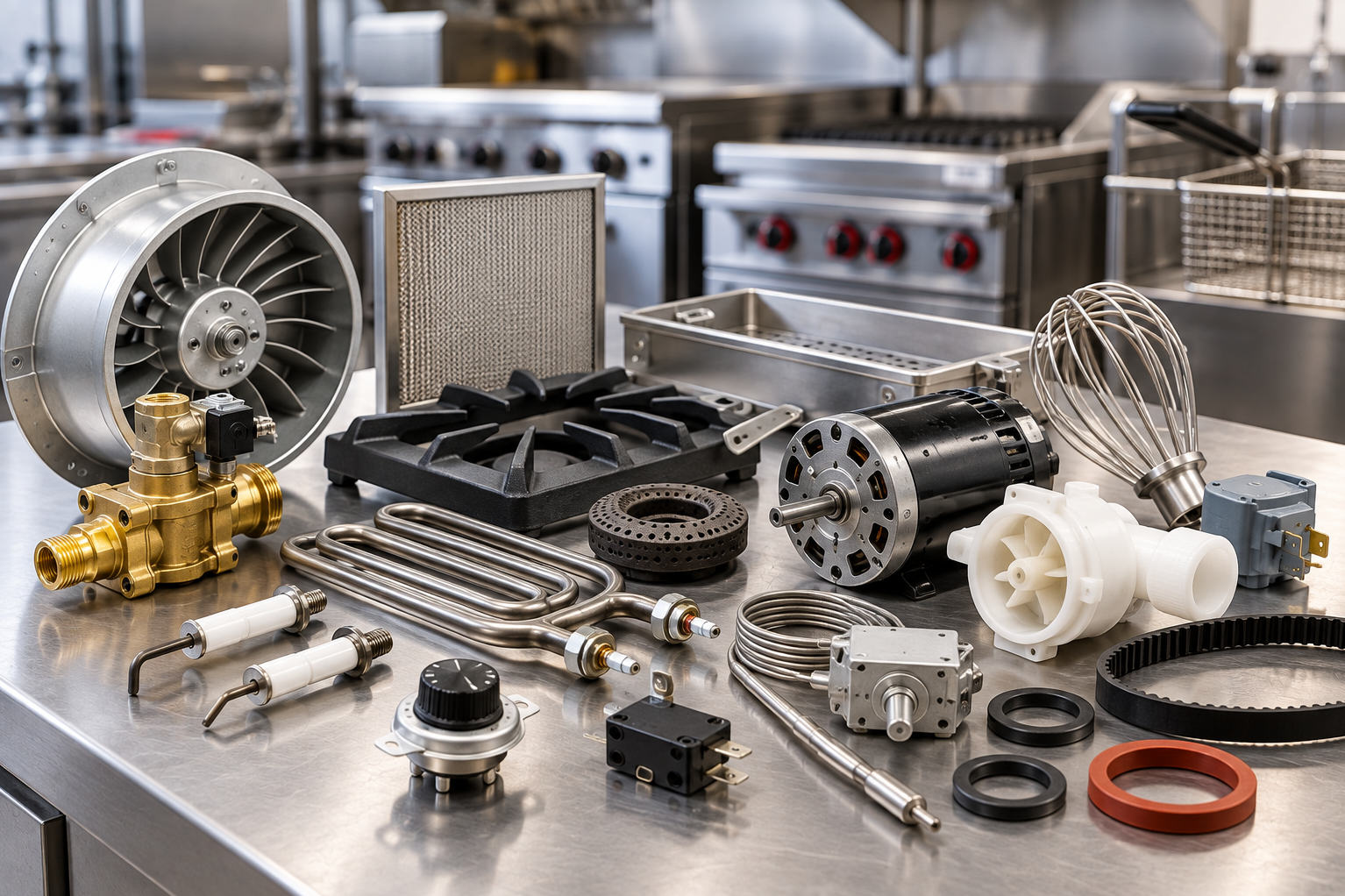
The exact components depend entirely on the equipment installed. Common categories encountered across commercial food-service systems can include:
- Switches and controls
- Thermostats
- Thermocouples
- Heating elements
- Contactors
- Relays
- Seals and gaskets
- Valves
- Motors
- Fans
- Belts
- Bearings
- Knobs and handles
- Electrical components
These should not be treated as universally interchangeable parts.
Each machine can require specific ratings, dimensions, connections and manufacturer-compatible components.
Separate Fast-Moving Parts From Rare Components
Not every spare deserves shelf space.
Parts that are inexpensive, frequently replaced and essential for operation may be practical to keep on hand. Expensive assemblies with low failure rates may be better sourced when required.
A useful classification system is:
Critical spares: Failure can stop essential operations.
Routine maintenance parts: Components regularly replaced during planned servicing.
Consumable items: Items used or replaced frequently.
Non-critical spares: Components whose failure does not immediately stop operations.
This method helps avoid both excessive inventory and unnecessary shortages.
Label Stored Components Clearly
A spare part is not useful if nobody knows which machine it belongs to.
Storage labels should identify the component description, part number, corresponding equipment, model and quantity.
Where possible, avoid mixing visually similar electrical or mechanical parts in the same unmarked container.
Review Inventory After Equipment Changes
Commercial kitchens evolve.
An old appliance may be replaced while its spare parts remain in storage. New equipment may arrive without corresponding critical spares being added to the inventory plan.
A periodic review keeps the spare-parts system aligned with the actual kitchen.
This is especially useful for hospitality businesses in Delhi NCR managing several kitchens or multiple properties.
Use Equipment Details When Ordering
When requesting Spare Parts for Food Service Equipment, provide the equipment make, model, serial number and component reference wherever available.
PCNS ENGINEERS Pvt. Ltd. supplies and supports commercial kitchen equipment and associated spare-part requirements in Delhi. Accurate machine information helps make discussions with any equipment service provider more productive.
A planned spare-parts strategy is ultimately about operational continuity. Kitchens that know their critical machines, document compatible components and maintain sensible inventory levels are better prepared to respond when routine wear or unexpected equipment problems occur.
Keywords