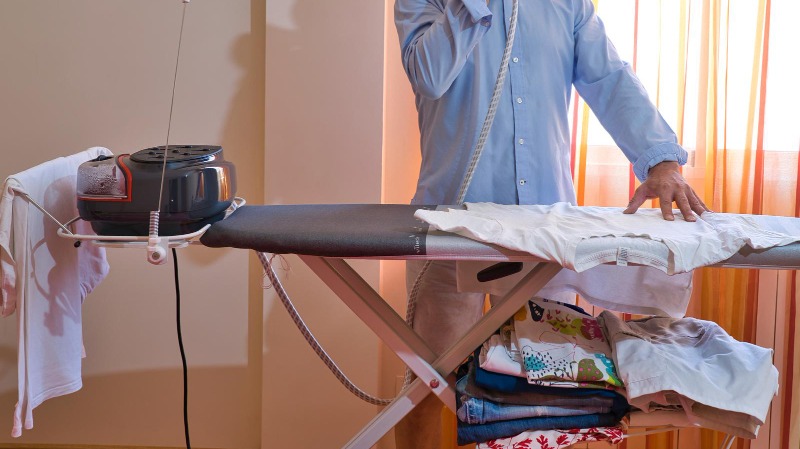
Garment finishing affects how cleaned clothing is presented to the customer. In professional laundries, hotels and dry-cleaning operations, a Vacuum Finishing Table can support pressing by drawing air through the working surface, helping control fabric during the finishing process.
Choosing a table should be based on workload, garment types, utility requirements and operator workflow rather than simply comparing table dimensions.
Understand the Vacuum Function
During pressing, steam and heat can leave moisture within fabric.
A vacuum finishing table draws air through the surface. Depending on the process and equipment configuration, this can help hold garments in position and assist cooling and drying after pressing.
The result depends not only on the table but also on the pressing technique, steam quality and garment characteristics.
Match the Table to Your Garments
A dry cleaner handling shirts, trousers, jackets and delicate garments has different requirements from a hotel laundry primarily finishing uniforms or linen-related items.
Before purchasing, consider:
- Typical garment categories
- Daily finishing volume
- Peak-hour workload
- Available floor space
- Operator working position
- Steam requirements
- Electrical supply
- Existing finishing equipment
This provides a much stronger basis for equipment selection than choosing by price alone.
Examine the Working Surface
The table should provide a suitable working area for the garments being processed.
Surface condition also matters because finishing depends on consistent airflow. Covers and padding should be maintained according to equipment requirements so that accumulated contamination or deterioration does not unnecessarily restrict vacuum performance.
Replacement consumables should be considered as part of long-term ownership.
Evaluate Operator Ergonomics
Finishing can involve repetitive work for extended periods.
The table height, pedal position, garment handling area and arrangement of nearby equipment can affect operator comfort and productivity.
A theoretically high-capacity machine may still create workflow problems if employees have to repeatedly reach across awkward spaces or move garments unnecessarily between stations.
For this reason, equipment layout should be planned around the complete finishing process.
Consider Maintenance Access
Vacuum motors, electrical components and related parts eventually require inspection or servicing.
Before purchasing, determine whether important components can be accessed without unnecessarily dismantling surrounding equipment.
Ask about routine cleaning requirements and the availability of compatible spare parts.
A table that is easy to maintain can be more practical over years of commercial use.
Calculate Capacity Realistically
Buying oversized equipment can consume unnecessary space and capital, while undersized equipment can become a bottleneck.
Review current finishing volumes and realistic growth expectations.
For laundry businesses in Delhi and the wider hospitality market, seasonal workload variation may also influence the required capacity.
Look Beyond the Purchase Price
A Vacuum Finishing Table should be evaluated through its total operating value.
Consider productivity, utility requirements, expected maintenance, spare-part availability and compatibility with the existing laundry setup.
PCNS ENGINEERS Pvt. Ltd. supplies and supports commercial laundry equipment in Delhi, including installation, spares, repair and maintenance requirements. A site-specific assessment can be particularly useful when a finishing table needs to integrate with existing equipment.
The right table should fit the garments, workload, operator and available utilities. Evaluating all four factors makes the purchasing decision considerably more practical.
Keywords